

ISB made macro optional.
Here it is anyway.

Somebody already explained macro to you — badly. A TV panel shouting past each other, a forwarded chart with no source. Meanwhile the repo rate set your EMI, the rupee priced your trip, and a yield curve you've never seen decided your offer letter. Prof. Tantri teaches the mechanism, not predictions — so the next time onions are setting the repo rate, you saw it coming.

Prof. Tantri, drawn in a single line, mid-question at the lectern

This week's question · class participation open

Loading this week's question…

Answer it → collect the karma
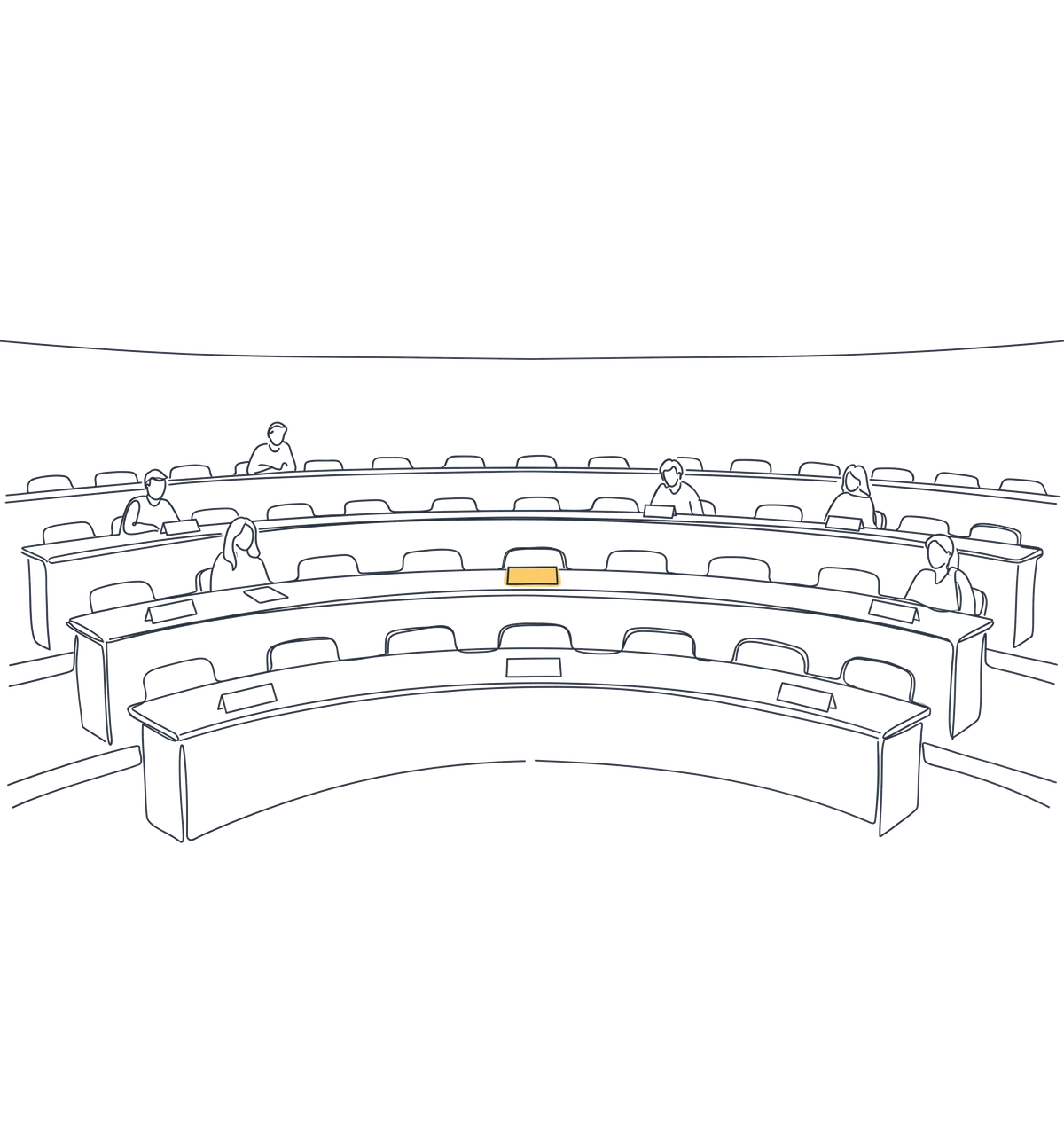
The tiered ISB lecture hall in line art — one name card lit up +2 karma

Best answer gets read out in class — name card and all. Sign in, answer this week's question, and the ledger remembers.

Today, in the history of moneyLoading…

What’s in the room

One lecture a week, notes that play, a calendar that rings before the news does, a brother-in-law who cites his sources, and the library he actually sends. That’s the room — the sign-in just opens the door.

01The Sunday session

One lecture a week. Because you forget.

Session 6 — Exchange rates & interest rate parity

1:04:00 · 7 chapters · notes the same evening

Every Sunday he teaches; by Sunday night the notes are up, chaptered, with screenshots from the recording. The video lands mid-week. Take them in order — the course builds.

Browse the sessions →
02The long reads

His notes, made playable.

Model №2 — the lender's arithmetic

10%

22.22%

what a risk-neutral lender charges so survivors cover the defaulters — his 110/90. Not profit, not a risk premium. Arithmetic.

Three courses as long reads — corporate finance, the Indian financial system, macro — from his own notes, with nineteen interactive models built on his exact numbers. Break them with your own hands; every one has a trap he sets in class.

Start with corporate finance →
03The timetable

The system runs on a schedule.

CPI on the 12th. WPI on the 14th. IIP on the 28th. Six MPC decisions a year, on dates the RBI publishes every March. When the print drops, you should already know what to ask it. Subscribe once; your calendar knows forever.

See the full timetable →
04Ask BIL coming soon

The brother-in-law, finally useful.

why is the lender's 22.22% not a risk premium?
Sighs. We covered this in term 1, but fine — with a known 10% default rate, survivors pay 110/90 so the lender earns the risk-free 10% in expectation. Certainty isn't risk; the premium is for the uncertainty around the 10%.
— source: FCRV June-10 notes, §2.3

Coming soon. Right now he's glued to the screen — the economy is behaving far too interestingly to look away, and he frankly doesn't have time for you. Unlike you, he studies the market from sources. The moment things get boring again he's all yours: ask him anything from the course, he answers correctly, cites the page, and makes sure you know it cost him nothing.

He's busy — peek anyway →
05The library

What he sends, with the verdicts.

RBI Bulletin — original data link rbi-fed

Do not use newspaper sources. The original data link is this.

Gormsen & Huber — Corporate Discount Rates paper

Firms do not change their hurdle rate when cost of capital changes.

Papers, RBI circulars, his own columns — each filed with the one line that tells you how to read it, verdicts verbatim. Plus the book club: one book a quarter, his pick.

Into the library →

Pick up where you left off.

Nothing in progress yet — open a note and it'll wait for you right here, with your spot saved.

Latest notes

RSS

New notes, essays and lectures — every update to the blog and the Sunday series lands here first.

  1. The Cheap Rupee: A Discount, Not a Crisis

    Session 16 — the rupee at 89 read properly: current account is fine, the capital account did the work; a cheap rupee is a discount that lifts exports; FDI turned up while FII stayed out; and the RBI's FCNR(B) grab for hot money was the one move it didn't need.

    • #exchange-rates
    • #rupee
    • #reer
    • #fdi
    • #fii
    • #rbi
  2. Reading India's Balance of Payments Without the Panic

    Session 15 — Tantri walks the actual BoP table, row by row, to show why the rupee's fall is a choice RBI is making, not a crisis it's suffering.

    • #balance-of-payments
    • #forex-reserves
    • #rupee
    • #india
    • #applied-macro
  3. RBI's Real Rate Mistake — and the Two Bad Choices Iran Just Handed India

    Session 14 — a live case study in a central bank's real-rate math going wrong: RBI cut rates on 1% inflation, pumped in 8.8 lakh crore, and now Iran's oil shock has arrived on top of it.

    • #monetary-policy
    • #india
    • #rbi
    • #real-interest-rate
    • #phillips-curve
    • #supply-shock
  4. The Phillips Curve, Finally Derived — and Why India Has Only Bad Choices Right Now

    Session 13 — the formal Phillips curve derivation, and why a supply shock leaves policymakers with two bad options and no good one.

    • #phillips-curve
    • #supply-shock
    • #inflation-expectations
    • #monetary-policy
    • #india
    • #crude-oil
  5. The rupee's depreciation is neither unusual nor indicative of great stress

    A polished essay Tantri sent into the WhatsApp group, originally published in Mint — using the RBI and BIS REER data to argue that the recent rupee weakness, far from being a crisis, is well within historical norms.

    • #exchange-rates
    • #rupee
    • #reer
    • #india
    • #monetary-policy
    • #tantri-files
  6. Tantri's exam: history-laced macro questions

    A walk through Tantri's INFS final exam — every question is a historical or pop-culture vignette, and the answer is always macro. Rothschild, the Spanish empire, George Soros, Shakespeare, and Operation Twist.

    • #exam
    • #macro
    • #history
    • #monetary-policy
    • #tantri-files
  7. You Can't Exploit the Phillips Curve Twice

    Session 12 — the historical Phillips curve, Samuelson and Solow's policy dial, and Milton Friedman's warning: inflation expectations adapt. The 1970s is the story of what happens when a government tries to keep the dial turned.

    • #phillips-curve
    • #inflation-expectations
    • #friedman
    • #monetary-policy
    • #history-of-thought
  8. Medium-Term Economics: Inflation, Labor & the Phillips Curve Foundation

    Session 11 — transition to medium-term macro: wage-setting, price-setting, the natural rate, and the institutional z variable.

    • #phillips-curve
    • #inflation
    • #labor-market
    • #medium-term
    • #natural-rate
  9. Union Budget 2025-26: A Macro Reading

    A standalone classroom reading of the Union Budget 2025-26 — fiscal stance, capex shift, tax changes, and the STT/SGB credibility problems.

    • #budget
    • #fiscal-policy
    • #india
    • #government-spending
    • #capex
  10. The Z Variable, and the Country That Just Broke a 40-Year Rule

    Session 10 — the wage-setting and price-setting equations get their formal introduction (full derivation in Session 11), then the class turns to Japan: four decades of near-zero rates, a carry trade the whole world quietly depends on, and the first sign it might be ending.

    • #medium-term
    • #labor-market
    • #japan
    • #carry-trade
    • #wage-setting
  11. Rising Rates: Is It Supply, or Is It Demand?

    Session 9 — a live diagnosis: are Indian interest rates rising because of a temporary liquidity squeeze, or because state and central governments are quietly printing money through borrowing? The rupee tells you which.

    • #monetary-policy
    • #interest-rates
    • #fiscal-policy
    • #mundell-fleming
    • #india
  12. Exchange Rates, Inflation & Interest Rate Parity

    Session 8 — inflation, nominal depreciation, and interest-rate parity: three apparently contradictory facts reconciled.

    • #exchange-rates
    • #inflation
    • #interest-rate-parity
    • #irp
    • #fisher
  13. Open Economy: Domestic Demand vs. Demand for Domestic Goods

    Session 7 — the Keynesian Cross goes open: domestic demand splits from demand for domestic goods, X and imports enter the model, and the rice example that will carry the next three sessions gets built from scratch.

    • #open-economy
    • #net-exports
    • #keynesian-cross
    • #exchange-rates
  14. Real Exchange Rates & Productivity

    Session 5 — medium-term macro: tradables vs. non-tradables, PPP, Balassa-Samuelson, and RBI data on India's REER.

    • #exchange-rates
    • #productivity
    • #balassa-samuelson
    • #ppp
    • #tradables
  15. Fiscal Policy, Crowding Out & Transmission

    Session 4 — the GST tax-cut case, government borrowing and crowding out, a five-step transmission walkthrough, and AI/human capital.

    • #fiscal-policy
    • #crowding-out
    • #transmission
    • #gst
    • #human-capital
    • #india
  16. IS-MP Framework & Modern Monetary Policy

    Session 3A — building the IS-MP framework, walking through policy applications, and India's macro constraints.

    • #is-mp
    • #monetary-policy
    • #rbi
    • #central-banking
    • #india
  17. Aggregate Demand & Monetary Policy

    Session 3 — real vs. nominal rates, liquidity preference, and the shift from IS-LM (money-supply) to IS-MP (interest-rate) monetary policy.

    • #aggregate-demand
    • #real-rates
    • #liquidity-preference
    • #is-lm
    • #is-mp
    • #monetary-policy
  18. The Keynesian Cross

    Session 2 — short-run Keynesian macro: the consumption function, the 45-degree cross, the multiplier, and the paradox of thrift.

    • #keynesian-cross
    • #consumption-function
    • #multiplier
    • #paradox-of-thrift
    • #short-run
  19. Economy in the Long Run

    Session 1 — foundations of long-run growth: pre-industrial stagnation, the leisure-work trade-off, and the island economy model.

    • #growth
    • #long-run
    • #island-economy
    • #deadweight-loss
    • #capital-formation

No notes match that search yet — try a different keyword or clear the filter.